
Everyone gives the same advice for a small room. Get rid of things. Clear the surfaces. Buy the white paint.
So you declutter. The room is tidier. It still feels cramped.
A cramped room is almost always a sightline problem, not a stuff problem. The way your eye travels through the space matters far more than how much is in it.
The thing your eye is actually doing
Walk into any room and your eye looks for the longest clear line it can find. A path across the floor. A view to a far wall. A run of open surface.
When it finds a long line, the room feels generous, even a small one. When the line keeps hitting an obstacle a few feet in, the room feels boxed in, even a fairly large one.
A room reads cramped less because of its size than because of where the eye stops.
This is why two rooms of identical square footage can feel completely different. One has a sightline. The other has a wall of short, interrupted views.
Designers call the long clear view a sightline. You don’t need the word. You just need to notice where your eye keeps stopping short.
Find where the line breaks
Stand in the doorway and look across the room. Where does your eye land first, and what stops it?
In most cramped rooms, the answer is one of these:
- A tall piece of furniture planted across the main view, a bookcase or wardrobe that chops the room in half the moment you walk in.
- The backs of seating turned toward you, so you meet a barrier instead of a path.
- A rug that floats too small, drawing a tight little box on the floor and shrinking the apparent footprint.
- Every wall busy at once, so there’s no quiet stretch for the eye to rest and no single long line to follow.
None of that is clutter in the tidy-up sense. You could dust every surface and the lines would still be broken.
Open one long line first
You don’t need to open every view. You need one good one. Give the room a single long sightline and the whole space breathes.
- Clear the diagonal. The longest line in any rectangular room is corner to corner. Pull furniture off that diagonal so the eye can run the full length when you walk in.
- Lower the thing that blocks the entry view. Swap a tall cabinet near the door for something low. A piece you see over keeps the far wall in play; a piece you see into ends the room early.
- Float the sofa off the wall, even an inch. A gap behind a sofa reads as space continuing past it. Pushed flat to the wall, it reads as the edge of the world.
- Size the rug to the furniture, not the leftover floor. A rug that reaches under the front legs of the seating ties the zone together and makes the floor read larger, not smaller.
Name the reason a room feels off before you reach for the fix.
Most of that costs nothing. You’re moving what you own, not buying more.
Borrow depth from light and reflection
Once the floor line is open, you can stretch the room a second way: give the eye somewhere far to look and something to bounce off.
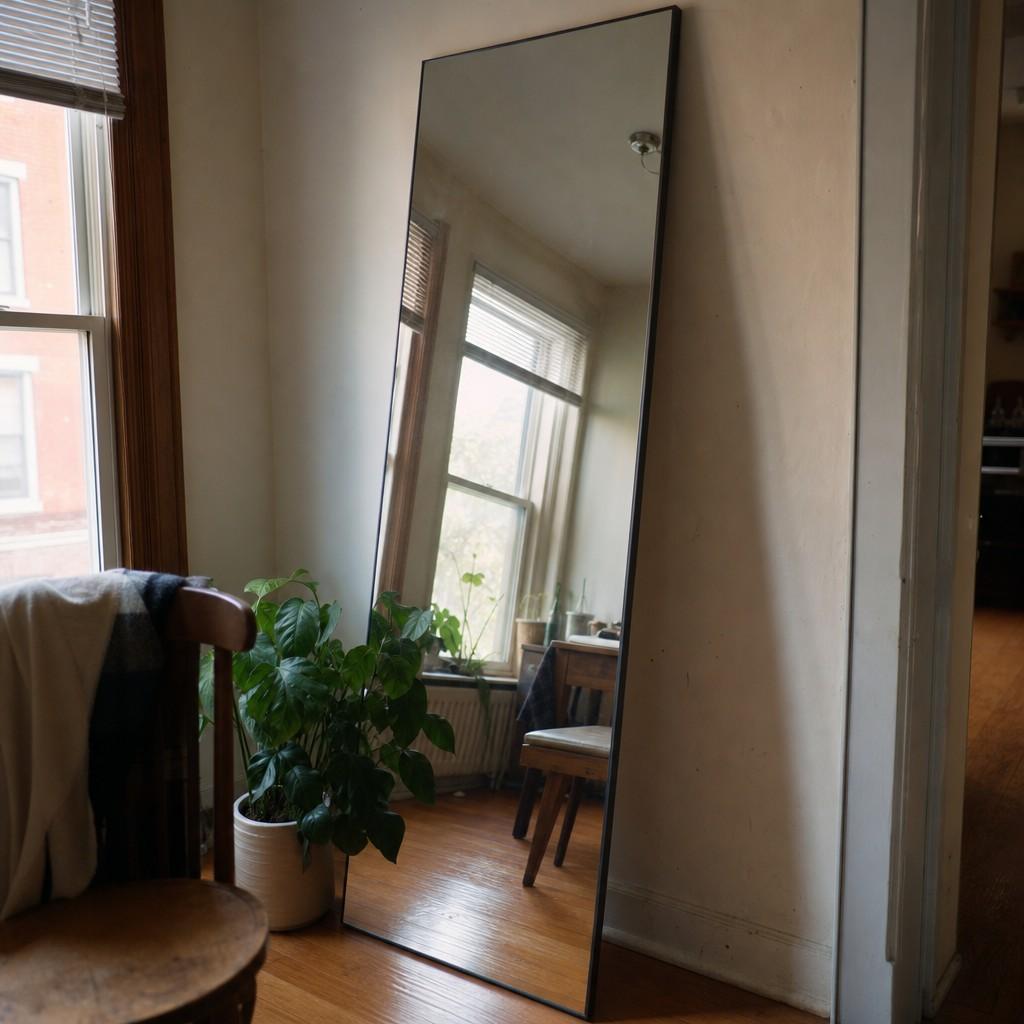
A tall mirror placed to reflect a window does two jobs at once. It throws a second source of daylight across the room, and it shows a view, which the eye reads as more space beyond the glass. Put it where it catches the window, not facing a blank wall.
Pull the curtain rod wide and high. Mount it close to the ceiling and let the fabric stack past the window frame on each side. The window looks bigger, the wall looks taller, and the eye travels up instead of stopping at a low line.
Keep the floor as visible as you can. Furniture on legs lets the floor run underneath, so the eye reads one continuous surface. Pieces that sit flat to the ground cut the floor into segments and the room shrinks with it.
Where decluttering does help
Clearing out has its place. It just isn’t the cause, so it isn’t the cure.
Once the long line is open, a clear surface along that line keeps the view clean instead of busy. So the order matters. Open the sightline first, then edit what sits along it. Declutter before you’ve fixed the lines and you get a tidy room that still feels tight.
The takeaway
A small room rarely needs less stuff. It needs one honest path for the eye to follow.
Open a single long sightline, then let light and a mirror stretch it further. The square footage doesn’t change. The feeling does, which was the whole problem in the first place.
You can make an ordinary room look considered without a designer’s budget. A room that finally feels its full size, mostly by moving what you already own, is exactly that.