
There’s a specific moment when a backyard with good lighting becomes obvious. It’s not noon. It’s after dark, when the yard stops reading as lawn-and-fence and starts reading as a room.
Most outdoor lighting misses this. It floods the space with brightness: floodlights aimed at the house, path lights that illuminate nothing worth seeing, a single overhead fixture that turns the patio into a parking lot.
Good outdoor lighting is not about visibility. It’s about what you make visible.
The same yard, lit differently, is two completely different spaces. One feels exposed. The other feels like somewhere you’d want to sit until midnight.
What light temperature does outside
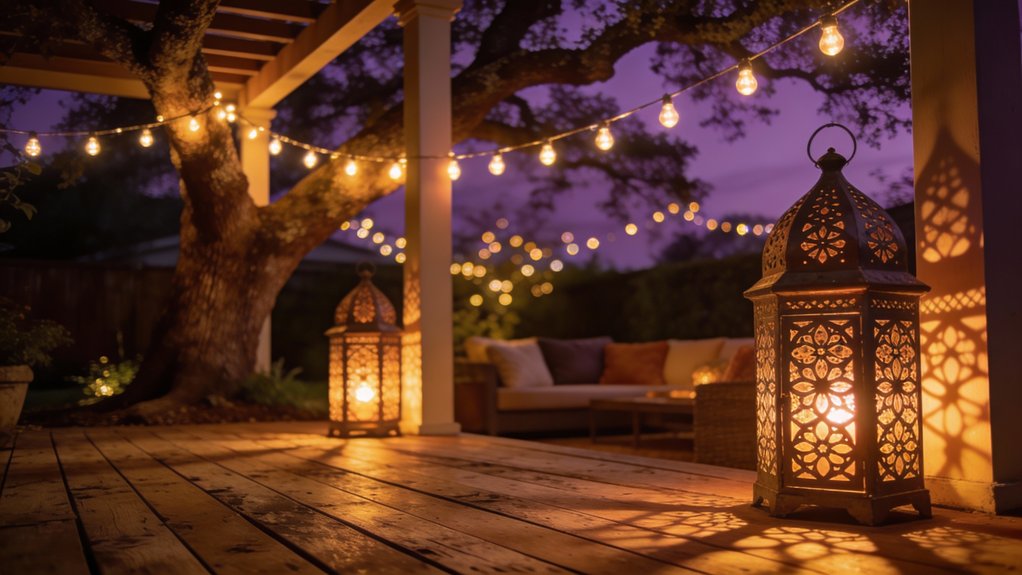
Indoors, light temperature is about undertone (how warm or cool a room reads). Outdoors, the stakes are higher, because there’s nothing to bounce off and no ambient ceiling to diffuse anything.
Warm light, in the 2700K to 3000K range, pulls a space inward. It’s inviting, soft, and reads as deliberate. That range is the accepted standard for residential warm white, the color closest to traditional incandescent and the one bulb makers label warm white.
Cool light, above 4000K, pushes outward and reads as task lighting. Under security lamps or bright overhead fixtures, it’s the right choice. In a space meant to feel like an outdoor room, it reads as institutional.
For seating areas and dining zones, stay in the warm-white range. Cool light in those zones drains the warmth from faces and materials. The outdoor room suddenly looks like a loading dock.
Good design is mostly decisions about light, color, material and proportion, not money.
Layer the light, don’t flood the space
The word “layer” gets used a lot in lighting guides, but the actual principle is simpler than it sounds.
A space with one light source looks flat. A space with multiple sources at different heights and intensities looks dimensional. The room has depth.
For an outdoor room, three sources is usually enough:
One ambient source overhead. String lights are the most forgiving way to do this: they produce a warm wash without the harshness of a single point fixture, and they define the ceiling of the outdoor room. Run them between anchor points at the height of a low ceiling, not draped at ground level.
One accent source at eye level or below. A lantern on a table, a candle in a hurricane glass, a low stake light at the edge of a planted border. This catches faces and textures at a more intimate scale.
One directional source for structure. An uplight on a tree or a wall-mounted fixture that grazes a surface. This gives the space a back wall, the visual edge that makes it feel like a room rather than an open field.
You don’t need all three to be wired. Solar stake lights and battery lanterns have improved enough to hold their own through an evening.
The one move that changes everything
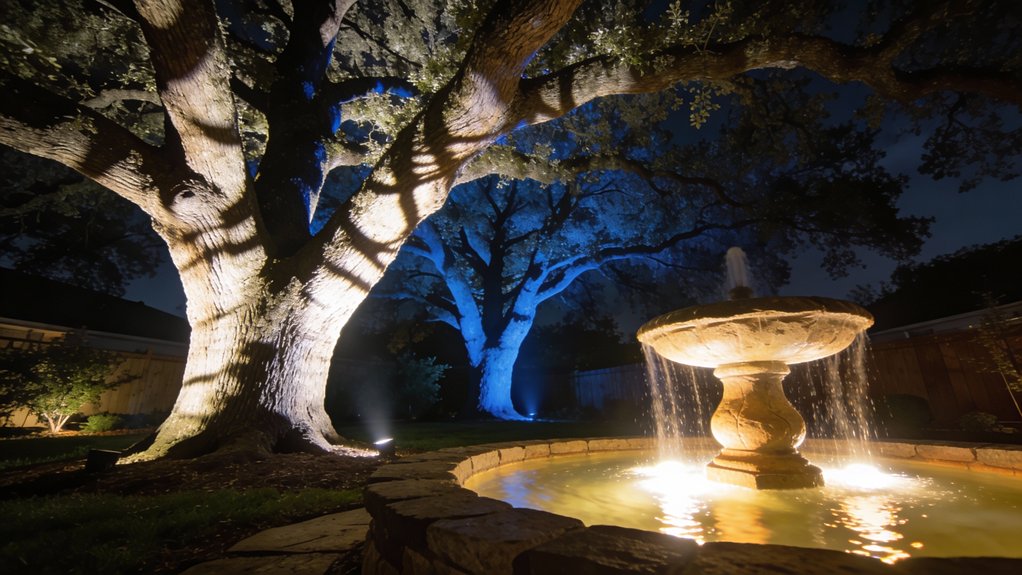
If you can only do one thing: add a warm-white string light across the overhead plane of your seating area.
That single change creates a ceiling where there wasn’t one. The outdoor room suddenly has a top edge, which is what was making it feel like exposure rather than enclosure.
Mount them at 8 to 10 feet if possible, close to the height of an indoor ceiling. Lower than that reads as decoration. Higher reads as nothing.
Pathway and perimeter lighting
Path lights serve a practical purpose, but they also do something else: they define the boundary of the space. Light along a garden bed edge or a stepping stone path draws the eye along a route and makes the yard feel structured.
The mistake is height. Most path lights point straight down, which illuminates the ground and nothing else. The effect reads as a series of lit spots, not as a coherent edge.
Low, angled stake lights that cast sideways across plants or gravel read better than upright bollards pointing at the pavement. They light the texture of the material rather than just the surface.
Keep them warm-white to stay coherent with the rest of the scheme. A mix of cool-white path lights and warm-white string lights makes the space look unresolved rather than designed.
Fire as a design element
A fire pit or chiminea earns its place in an outdoor room not just because of warmth, but because it acts as a natural focal point.
Seating arranged around a fire pit has an obvious center. Seating in a backyard without one often doesn’t.
Position fire 10 to 15 feet from seating. Closer and the warmth is overwhelming; further and the effect is decorative rather than functional. The flickering is doing real work: it animates the faces of people around it and creates movement in an otherwise static space.
You can make an ordinary outdoor room look considered without a designer’s budget. A thoughtfully placed fire element (even a simple tabletop version on a covered deck) contributes as much to the room’s reading as any furniture choice.
Wiring versus wireless
Neither is automatically better. The right answer is what you’ll actually install and maintain.
Solar lights require nothing beyond placement, but they need direct sun to charge effectively and often fade before the evening is over in shadier yards. Test the specific product in your conditions before committing.
Wired low-voltage landscape lighting is reliable and dimmable, but requires a transformer and some digging. For a permanent scheme it’s worth the investment; for a rental or a first-season setup, wireless is a reasonable start.
The goal in either case is the same: warm light at multiple heights, scaled to the space, aimed at what’s worth seeing. That’s the whole brief for an outdoor room after dark.