
The phrase “outdoor living space” gets used as if it describes a size. Big yard, outdoor living space. Small yard, patio. Smaller still, nothing much.
That’s not how it works.
An outdoor room is a design decision, not a square footage threshold. A 100-square-foot concrete slab outside a rental apartment can function as a room. A half-acre yard with expensive furniture can feel like a field you happen to own.
The difference is whether the space has been made to feel bounded, purposeful, and inhabitable.
That is a design problem. It doesn’t require a budget or a landscaping contractor. It requires making a few decisions on purpose rather than by default.
The one thing that makes it a room
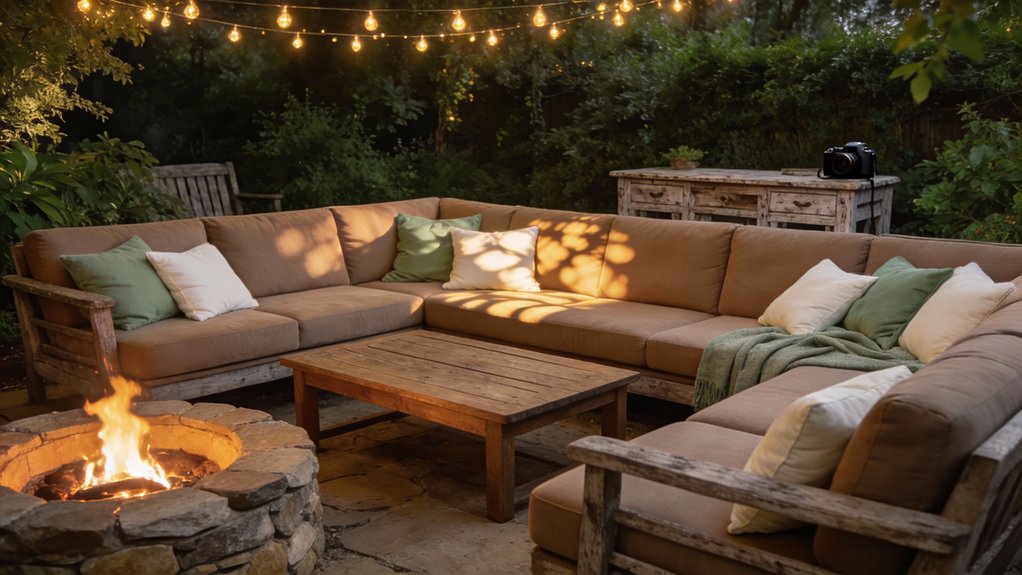
Rooms have edges. That’s what separates them from open space.
Inside, the walls do this automatically. Outside, nothing is automatic. If you don’t create edges, the yard reads as an outdoor space rather than an outdoor room, pleasant enough, but without the feeling of being somewhere specific.
Name the reason a room feels off before you reach for the fix.
The fastest edge you can create is overhead. A pergola, a shade sail, a set of string lights strung between posts: anything that defines a ceiling plane over the seating area immediately makes that area feel like a room within the yard. The sky is still there; you’ve just marked out a portion of it as yours.
The second edge is the perimeter. A planter at the corner, a screen, a low wall of stacked block, a tall pot, a fence panel. It doesn’t need to enclose the space fully. It needs to suggest a boundary: a back wall, a side wall, something that stops the eye from simply continuing to the property line and giving up.
Seating as room furniture, not yard furniture
Most outdoor seating is arranged the same way: pieces pushed against the edges of the patio, facing outward toward the garden.
This is yard furniture, not room furniture. Room furniture faces inward. It creates a center.
Turn the seats to face one another, or a shared focal point, rather than the property line. Two chairs cornered around a low table, or a short run of seating bent into an L, is enough to read as a deliberate gathering spot instead of scattered pieces.
A focal point helps enormously. A fire pit, a planted urn, a water feature: something that gives the seating a reason to orient itself. It doesn’t have to be expensive. A large pot with a well-chosen plant does the same visual work as a sculptural fire bowl at a tenth of the price.
What comfort means outside
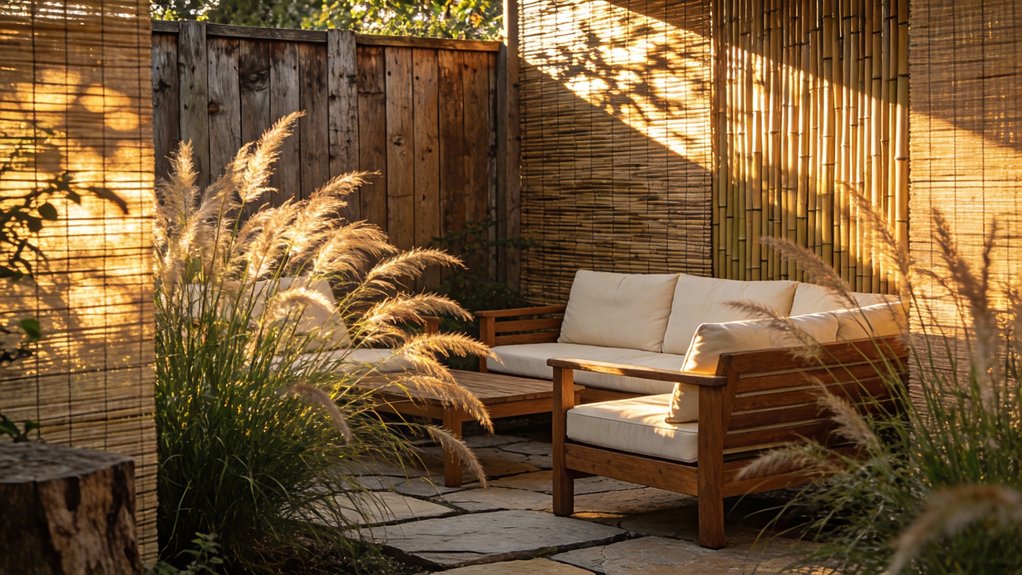
Outdoor comfort fails for two reasons: temperature and surface. Both are solvable.
For temperature: shade in summer and warmth in autumn are the practical levers. A large umbrella or a shade sail handles the first. A fire element or a string of outdoor heating panels handles the second. Neither requires a major installation.
Cushions are the shortcut most outdoor rooms need. Hard furniture you wouldn’t sit on for more than 10 minutes becomes a place you’ll stay for two hours with a properly cushioned seat. Look for solution-dyed fabrics rather than printed ones. Their pigment is locked into the fiber itself instead of sitting on top, which is what lets them shrug off a season of sun.
Throws and blankets stored in a weatherproof bin nearby extend the season by weeks. They’re cheap. Most outdoor rooms don’t have them, which is one reason most outdoor rooms get abandoned when the evenings cool.
Material coherence
An outdoor room that reads as designed almost always has one thing in common with its indoor equivalent: the materials are consistent.
This doesn’t mean everything matches. It means everything belongs to the same family: the same temperature (warm or cool), the same register (natural or industrial), the same era of feeling. Teak and rattan and terracotta belong together. Powder-coated steel and concrete and engineered stone belong together. Mixed randomly, they suggest a yard that accumulated rather than was designed.
Pick a material direction and hold it. Two or three materials maximum, related in feeling. Everything else gets edited out or stored away.
You can make an ordinary outdoor room look considered without a designer’s budget. The material decision costs nothing if you’re working with what you already own. It’s about what you keep visible, not what you buy.
Privacy as design, not just function
Most privacy solutions are thought of as screens from neighbors. That’s a function, but it’s also a design opportunity.
A tall planted border doesn’t just block the sightline from next door. It creates a background for the outdoor room, a green wall that gives the space depth and makes the seating area feel nested rather than exposed.
A slatted screen, a bamboo panel, or even a row of identical pots at height can do the same thing. The key word is consistency: one type of screen, repeated, reads as a design decision. A mismatched collection of panels and shrubs and fencing reads as things that were added to solve problems over time.
Treat the perimeter as the room’s wall, not just the boundary. What it looks like matters, not just what it does.
The outdoor room in a small space
The design decisions above apply at every scale. A 6-by-8-foot balcony with one chair, a small table, a hanging plant, and a single string of warm lights is more of a room than a 40-foot garden with furniture scattered around the perimeter and no overhead definition.
Taste is a set of repeatable choices, not a gift you either have or don’t. An outdoor room gets made by making a few of those choices (overhead edge, inward-facing seating, one focal point, consistent material, a layer of warmth) and then stopping before the adding instinct takes over.
The outdoor room most people want already exists in the space they have. It’s waiting for a decision, not a renovation.